
An Ultrasonic Disperser uses high-frequency sound to help break apart particles and distribute them through a liquid. A probe, also called a sonotrode, transfers vibration into the sample. This creates rapidly forming and collapsing bubbles, a process known as cavitation. The resulting local forces can reduce agglomeration and improve mixing in suitable materials. It is not magic.
In practice, results depend on more than the instrument. Probe design, amplitude, processing time, sample volume, viscosity, and temperature can all affect dispersion. A small beaker may heat quickly during treatment, so monitoring temperature and using pulse mode or external cooling can be useful. Operators should also select equipment and settings appropriate to the material, since excessive energy may damage sensitive components or wear the probe. Details matter.
This guide explains how an ultrasonic disperser works, where it is commonly used, and what to consider when choosing one. It also distinguishes dispersion from processes such as emulsification and homogenization, which may overlap but are not always interchangeable. Results should be checked with a method suited to the sample, rather than judged by appearance alone. That is easy to overlook. No single setting works for every formulation, and published specifications cannot replace a controlled trial with the actual material.
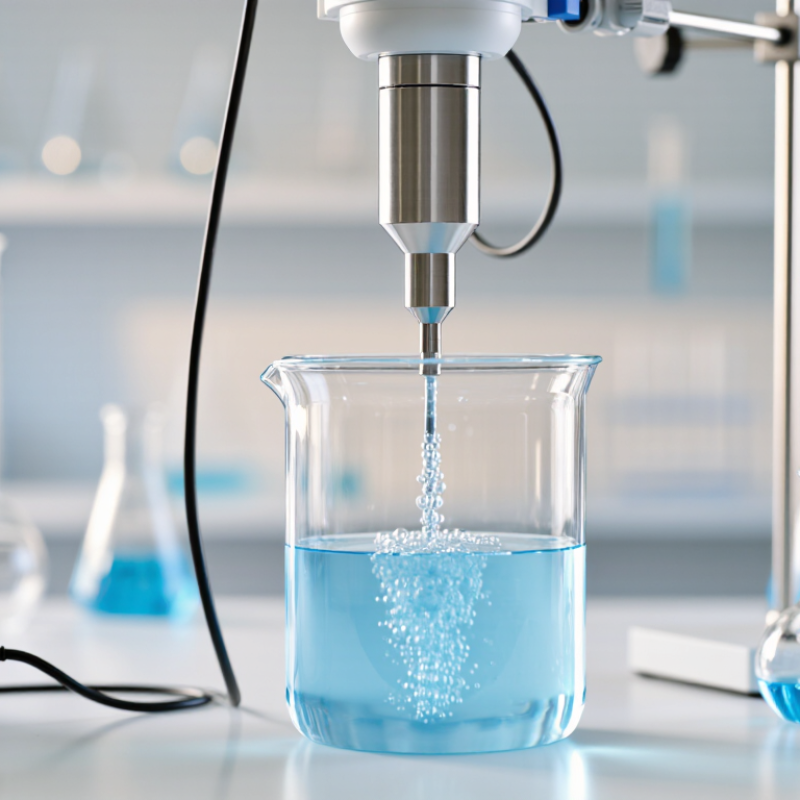
An ultrasonic disperser is a laboratory or process tool that uses high-frequency sound to break apart particles suspended in liquid. Many models send electrical energy to a transducer, which vibrates a metal probe immersed in the sample. The probe transfers that motion into the liquid. Tiny bubbles form and collapse rapidly, creating local forces that can separate particle clusters and help distribute powders more evenly. The effect is called cavitation. It is not simply stirring faster.
In practical use, a disperser may process pigment, ceramic, or other fine-particle mixtures. A narrow probe can work in a small beaker, while larger systems suit bigger volumes. The sample’s viscosity, volume, and composition all affect the result. So does the probe’s position. Keep it submerged, but avoid letting it touch the vessel. Small details count. A cloudy sample may become more uniform, yet ultrasonic treatment can also warm it or damage sensitive materials. I would not treat “more power” as an automatic fix; it may add heat without improving dispersion. Operators typically adjust amplitude and treatment time, then check the sample and repeat as needed. The best settings are often specific to the material, and a quick visual check alone may not reveal every particle-size change.
An ultrasonic disperser has several parts that work together to transfer high-frequency vibration into a liquid. The electrical generator supplies a controlled signal, and the transducer converts it into mechanical motion. A probe, often called a sonotrode, carries that motion into the sample. Its tip vibrates rapidly, creating pressure changes that form and collapse tiny bubbles. This cavitation can break apart agglomerates and distribute particles through the liquid.
Small details matter. The vessel holds the sample, while a clamp or support keeps the probe steady and safely immersed. The probe should not touch the vessel wall or bottom; contact can damage equipment and produce uneven results. Controls let an operator adjust amplitude and treatment time. Some systems also use pulsing to limit heat buildup. Heat builds quickly. A cooling bath or jacket may help protect temperature-sensitive samples.
In practice, setup is less tidy than diagrams suggest. Vessel shape, liquid viscosity, and probe depth can all affect dispersion, so a setting that works for one sample may not work for another. Inspect the probe for wear, and record operating conditions when comparing batches. This is easy to overlook. Ultrasonic treatment can improve uniformity, but it does not guarantee a stable formulation; particle settling may still occur later.
An ultrasonic disperser breaks particles through rapid pressure changes in a liquid. Its probe vibrates at high frequency, forming alternating compression and rarefaction waves. When the pressure falls enough, tiny vapor bubbles appear. They grow, then collapse sharply. That collapse is cavitation.
The collapse creates intense, highly localized forces. Kenneth S. Suslick’s review in Science (1990), “The Chemical Effects of Ultrasound,” reports cavitation hot spots near 5,000 K and 1,000 atmospheres. These are transient bubble-scale conditions, not the temperature of the whole liquid.
The implosions also produce microjets and shock waves that can disrupt particle clusters and expose fresh surfaces. In a beaker, this may look like a cloudy mixture becoming more uniform, though appearance alone cannot confirm particle size.
Results depend on probe depth, acoustic power, treatment time, viscosity, and cooling. Too much energy can heat the sample or damage sensitive materials. It is not magic.
A practical check is to compare particle-size measurements before and after treatment, while recording temperature and processing conditions. Even then, the probe’s energy does not always distribute evenly through the vessel.
An ultrasonic disperser uses high-frequency sound to break up particle clusters in a liquid. The sound travels from a vibrating probe into the sample, creating tiny bubbles. These bubbles form and collapse rapidly, producing localized forces that help separate particles. The process is called cavitation. It is powerful, but not gentle.
Prepare a uniform slurry by adding the material gradually to the liquid while stirring. Place the vessel on a stable surface, then lower the probe tip into the sample without letting it touch the sides or bottom. Start at a low setting and use short pulses. Watch the liquid closely: foaming, splashing, or a fast temperature rise can signal that the conditions need adjustment. Keep the sample cool when heat-sensitive ingredients are involved. A small ice bath may help.
After each pulse cycle, inspect a sample for visible clumps or settling. For more reliable results, compare particle size or dispersion consistency using a suitable measurement method. Adjust the amplitude, pulse duration, or processing time in small steps; the right combination depends on the material and sample volume. Clean the probe between batches to prevent carryover. Even then, a smooth-looking liquid can hide uneven particles.
That part is easy to miss.
An ultrasonic disperser uses a vibrating probe to send high-frequency sound through liquid. Alternating pressure creates microscopic bubbles; their collapse helps break particle clusters and disperse solids. In a 1990 Science paper, chemist Kenneth Suslick reported that collapsing cavitation bubbles can create localized temperatures near 5,000 K and pressures around 1,000 atmospheres. These are brief, microscopic conditions—not the temperature of the whole batch.
Dispersers are used to prepare pigment suspensions for paints and inks, mix battery electrode slurries, and process cosmetics and laboratory samples. Results depend on amplitude, probe immersion, batch volume, viscosity, and processing time. High nominal power alone does not guarantee a uniform dispersion. A narrow vessel or shallow probe placement can leave poorly treated zones; excess energy may heat the sample or wear the probe. Small details matter. One limitation is that visual smoothness cannot confirm particle size or long-term stability, so measurement may still be needed.
Tips: Start with a small batch, keep the probe tip submerged without touching the vessel, and use pulse mode with cooling for heat-sensitive liquids. Record amplitude, duration, and temperature so the process can be repeated—and adjusted when results disappoint.
| Category | Item | How It Works or Why It Matters |
|---|---|---|
| Definition | Ultrasonic disperser | A device that uses high-frequency mechanical vibrations to disperse, deagglomerate, or emulsify materials in a liquid. |
| Main components | Generator, transducer, and probe | The generator supplies electrical energy, the transducer converts it into mechanical vibration, and the probe transfers that vibration into the liquid. |
| Operating principle | Acoustic cavitation | Ultrasonic waves create and collapse microscopic bubbles in the liquid. Their collapse produces localized shear forces and fluid movement that can break up particles and droplets. |
| Common use | Nanomaterial and particle dispersion | Helps reduce agglomeration and distribute particles more evenly in a liquid, subject to the material, formulation, and process conditions. |
| Common use | Emulsification | Can help break one liquid phase into smaller droplets within another, such as during preparation of some oil-in-water or water-in-oil emulsions. |
| Common use | Cell disruption and sample preparation | Can disrupt cells or biological material to release contents for laboratory analysis. Appropriate cooling and process validation may be important for sensitive samples. |
| Common use | Pigment, ink, and coating preparation | Can assist with wetting and dispersing solid pigments in a liquid carrier, helping produce a more uniform mixture. |
| Operating factor | Amplitude and delivered power | Higher amplitude generally increases probe vibration intensity, but the delivered energy also depends on the probe, sample, and equipment. Excessive intensity can cause heating, foaming, or material damage. |
| Operating factor | Processing time and duty cycle | Longer or more continuous sonication increases energy input. Pulsed operation can provide cooling intervals; the appropriate settings depend on the sample and the desired result. |
| Operating factor | Temperature control | Ultrasonic energy can heat a sample. Monitor temperature and use cooling when needed, especially for heat-sensitive materials or extended processing. |
| Operating factor | Probe immersion and position | Keep the probe tip immersed in the liquid and positioned according to the equipment guidance. Poor placement can reduce coupling or introduce excessive air and splashing. |
| Operating factor | Volume, viscosity, and vessel geometry | These affect how acoustic energy is distributed through the sample. A setting that works for one volume or formulation may not work equally well for another. |
| Process check | Reproducibility and safety | Record sample volume, probe configuration, amplitude, time, and temperature. Use suitable hearing protection or an enclosure where required, and follow the equipment and material safety guidance. |
sale@harbertpump.com,
sale@harbertpump.com