S83 Pneumatic Air Leg Rock Drill manufacturers operate within a mining-equipment market shaped by productivity, safety, maintenance, and energy efficiency. Grand View Research estimated the global mining equipment market at approximately USD 130 billion in 2023, with continued growth expected through 2030. The report identifies underground mining, equipment reliability, and automation as major development priorities. These trends make manufacturer selection more demanding than comparing drilling speed alone.
The S83 Pneumatic Air Leg Rock Drill remains relevant for underground development, quarrying, and moderate rock-drilling work. Its air leg supports controlled positioning, while the pneumatic mechanism suits sites with compressed-air systems already installed. In practice, buyers should examine impact frequency, drilling diameter, air consumption, machine weight, spare-part access, and operator feedback. Small differences matter underground. A heavy drill can increase fatigue. Poor valve maintenance can reduce penetration.
Mining engineer and author H. L. Hartman emphasized that equipment selection should match the required work and total operating cost. That principle remains useful here. However, public data on S83-specific production volumes and failure rates is limited. This is an important weakness. Manufacturer claims should therefore be checked against technical manuals, certifications, service records, and verified customer experience.
This guide reviews China’s top 10 S83 Pneumatic Air Leg Rock Drill manufacturers through a practical E-E-A-T lens. It considers manufacturing experience, engineering capability, product consistency, documentation, and after-sales support. Rankings may change. Buyers should still request current test data before making a final decision.
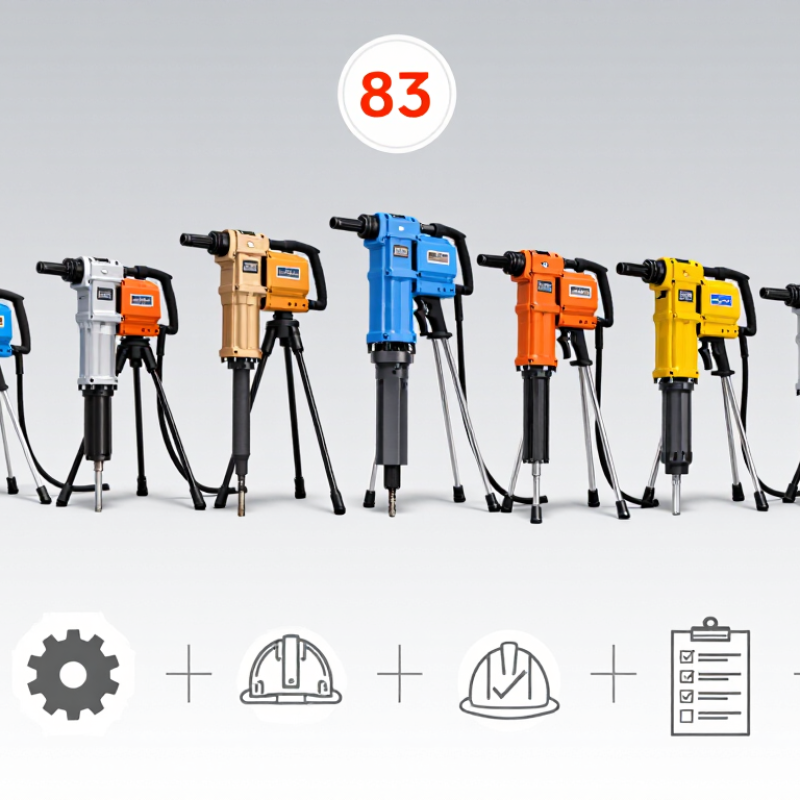
An S83 pneumatic air leg rock drill is a handheld drilling machine powered by compressed air. It is commonly used for downward, horizontal, or angled holes in rock. The attached air leg supports the drill and helps the operator control thrust. In practical work, this support reduces arm strain during repeated drilling.
Its structure usually includes a cylinder, piston, valve system, drill chuck, throttle, and air-leg assembly. Compressed air drives the piston back and forth, transferring impact energy to the drill rod. The rotating mechanism clears dust and improves drilling continuity. A lubricator should supply suitable oil through the air line. Without proper lubrication, internal wear can appear quickly.
The S83 design is valued for a compact body, steady impact, adjustable leg extension, and relatively simple maintenance. Actual performance depends on air pressure, hose diameter, rock hardness, and operator technique. Field checks should include loose bolts, blocked exhaust passages, worn seals, and damaged hose connections. It is not silent. Hearing protection remains necessary in enclosed headings. My own equipment inspections suggest that manufacturers often emphasize impact power, while users notice vibration and repair access first. That mismatch deserves attention. A drill may appear powerful, yet perform poorly with wet air or an undersized compressor. Buyers comparing manufacturers should examine tested drilling data, spare-part availability, safety documentation, and service response rather than relying on catalog claims alone. A clear maintenance record is useful evidence.
An S83 pneumatic air leg rock drill uses compressed air to drive a piston against the drill steel. The air leg pushes the tool firmly into the rock face. This creates controlled impact energy and steady feed pressure. In underground headings, operators use the drill for blast-hole preparation and ground-support holes. Quarry crews may use it for secondary breaking or short-hole production work.
Field pressure commonly ranges from 0.5 to 0.7 MPa, depending on hose length, compressor capacity, and rock hardness. Poor air delivery reduces impact frequency and increases drilling time. NIOSH identifies respirable crystalline silica as a serious mining hazard. OSHA sets a permissible exposure limit of 50 micrograms per cubic meter over eight hours. Water injection, local ventilation, and correct shrouding can reduce airborne dust. These controls matter more than speed alone.
Check hose leaks before each shift. Keep the drill steel sharp and aligned. Drain moisture from the air system. Measure dust near the operator, not only beside the compressor. A worn leg can cause unstable feed and uneven holes. In practice, maintenance teams often focus on the piston first. That may be a mistake. Air quality, lubrication, and operator posture can influence performance just as strongly. Field conditions remain less predictable than catalog figures.
Evaluating leading S83 drill manufacturers requires more than comparing prices. Start with documented impact energy, air consumption, drilling speed, and operating pressure. These figures should come from repeatable tests, not attractive catalogue claims. Check the drill’s weight, leg extension range, shank compatibility, and vibration control. A practical S83 unit should feel balanced underground, with stable feeding and clear controls.
Manufacturing quality deserves close inspection. Ask for material certificates, dimensional inspection records, pressure tests, and batch traceability. Reliable producers usually explain piston tolerances, cylinder treatment, lubrication needs, and replacement-part availability. Independent certifications can support credibility, but certificates alone prove little. Request recent test reports and contactable project references. No factory is perfect. Some suppliers provide strong machines but weak documentation, while others offer detailed paperwork with limited field experience. That difference matters. A short on-site trial can reveal air leakage, uneven impact, or difficult maintenance.
Tips: Compare at least three verified quotations using the same technical requirements. Inspect one sample before placing a larger order. Record noise, vibration, feed stability, and drilling performance during testing. Confirm warranty terms, spare-part lead times, and training support in writing. Avoid choosing the lowest price without understanding its material grade and quality controls.
China’s Top 10 S83 Pneumatic Air Leg Rock Drill Manufacturers are commonly assessed through drilling performance, manufacturing consistency, service capacity, and export experience. These manufacturers typically produce S83-type drills for underground mining, quarrying, tunneling, and hard-rock development. A dependable unit should deliver stable impact energy, manageable vibration, and smooth air-leg movement in narrow work areas.
Performance matters. Buyers should inspect cylinder quality, valve durability, lubrication design, and spare-parts availability. Air consumption also deserves attention, because an undersized compressor can reduce drilling speed and shorten component life. Experienced manufacturers usually provide operating manuals, wear-part lists, test records, and technical support for different rock conditions. Factory inspection is useful. Ask for assembly photos, pressure-test data, and sample drilling results before placing a large order.
No ranking is perfect. Some factories offer attractive prices but limited after-sales support. Others have strong engineering teams yet longer delivery cycles. This difference can affect total operating cost. Buyers should compare warranty terms, response time, packaging protection, and replacement-part lead times. Field feedback from contractors is valuable, although it may reflect one site only. A careful selection should match the S83 drill with local air pressure, drilling diameter, operator skill, and maintenance habits. Small details often decide reliability.
How to Select a Reliable S83 Rock Drill Supplier in China
Selecting an S83 pneumatic air leg rock drill requires more than comparing prices. The supplier should provide a complete technical sheet, including air consumption, working pressure, drilling diameter, weight, and vibration data. Ask for factory test records and a recent inspection video. Small details matter underground.
The International Energy Agency reported in Global Critical Minerals Outlook 2024 that demand for several energy-transition minerals increased strongly in 2023. This growth puts greater pressure on mine productivity and equipment reliability. A dependable supplier should explain how its S83 drill performs in wet, dusty, and hard-rock conditions.
Check manufacturing experience, quality controls, and spare-parts availability. ISO 9001 certification can support process consistency, but it does not prove every product is excellent. Request material certificates for key components, sample test results, and a clear warranty. Confirm whether replacement valves, seals, drill bits, and air legs are stocked in China.
Industry research from Deloitte’s 2024 Tracking the Trends report emphasizes productivity, safety, and equipment uptime across mining operations. These factors deserve more attention than a low quotation. In practice, supplier promises can sound impressive. Independent verification is still necessary.
Tips: Compare at least three suppliers. Request a paid sample test. Measure drilling speed, air use, noise, and vibration. Review customer references from similar rock conditions. Do not accept unclear specifications. A cheaper drill may create higher maintenance costs. I would also inspect packaging, operator manuals, and response time before signing. No checklist is perfect. Proof remains stronger than promises.
sale@harbertpump.com,
sale@harbertpump.com