Choosing the right Dual Exhaust Tips involves more than comparing polished finishes or attractive prices. Global buyers need dependable fitment, durable materials, and clear supplier information. A tip may look impressive online, yet fail to match the pipe diameter, bumper opening, or vehicle exhaust layout. Small measurement errors can create expensive delays.
This guide examines ten practical options for different vehicles, climates, and purchasing requirements. Stainless steel tips often suit coastal regions because they resist moisture and surface corrosion. Carbon-fiber-look finishes can provide a sportier appearance, but their coating quality requires careful inspection. Clamp-on designs support easier installation, while welded tips may offer a cleaner, more permanent finish. Not every option fits every market.
Real purchasing experience shows that product photographs rarely tell the entire story. Buyers should request dimensional drawings, material grades, finish samples, packaging details, and installation instructions. Supplier communication matters too. A reliable manufacturer should explain tolerances, production capacity, inspection procedures, and replacement policies without vague promises. Certification needs may also differ between countries, so local vehicle and import requirements deserve verification.
Fitment comes first.
The ranking considers appearance, construction, installation effort, corrosion resistance, and long-term value. It also recognizes practical concerns, including shipping damage and inconsistent surface polishing. Some products perform well but offer limited customization. Others look premium but provide weak documentation. That distinction is easy to miss. This comparison is not a perfect answer for every buyer, and conclusions may change with vehicle type, climate, and supplier quality. Careful inspection remains essential before placing a large international order.
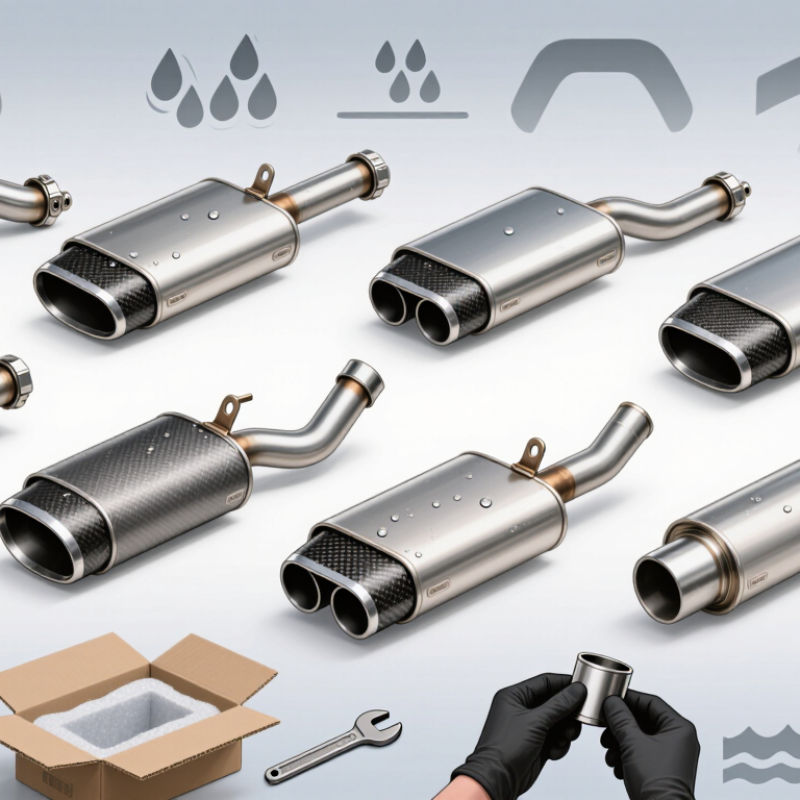
Dual exhaust tips are not one universal product. Their shape, inlet size, and pipe connection determine whether they fit correctly. A dual-outlet tip uses one inlet and splits exhaust flow into two visible outlets. A paired-tip setup uses two separate inlets for two exhaust pipes. These designs may look similar from the rear, but installation requirements differ.
Common inlet sizes range from 2.5 to 4.0 inches. The inlet must match the outside diameter of the vehicle’s exhaust pipe. A 3.0-inch tip will not reliably fit a 2.75-inch pipe without a suitable adapter or sleeve. Measure the pipe after removing rust and surface buildup. Measure twice. That mistake is common. Outlet diameter affects appearance more than basic fitment, while outlet spacing must clear the bumper cutout.
SAE fitment usually refers to inch-based sizing and practical dimensional compatibility, not a universal certification for every exhaust tip. Buyers should confirm whether the listed inlet measurement means inside diameter or outside diameter. Clamp-on tips suit many serviceable installations, while weld-on types require cleaner preparation and stronger alignment. Check wall thickness, clamp range, material, and total length before ordering. I have seen a correct inlet size fail because the tip was too long. Vehicle trim, hanger position, and bumper depth still matter. A simple drawing with four measurements can prevent an expensive mismatch.
When comparing the top ten dual exhaust tips, material deserves more attention than polished appearance. Grade 304 stainless steel is a practical choice for many global driving environments. It commonly contains about 18% chromium and 8% nickel. Chromium helps form a protective oxide layer, while nickel improves toughness and corrosion resistance.
In workshop inspections, I check the welds, wall thickness, inlet diameter, and edge finish. Clean welds reduce weak points around the outlet. A smooth inner surface also helps prevent soot from collecting unevenly. Measure twice. A tip can look correct but still fail to match the pipe diameter. Clamps should sit evenly, without crushing thin tubing.
Climate changes the buying decision. Coastal roads expose metal to salt, while humid regions encourage surface staining. In colder areas, road chemicals may attack poorly finished parts. 304 steel usually performs well, but it is not completely stain-proof. That detail matters. Heat can create golden or blue discoloration near the outlet, even when the material remains structurally sound.
I once rejected a visually attractive tip because its inner weld was rough and misaligned. The error was small, yet installation required extra adjustment. Buyers should request clear material information, accurate measurements, and close-up weld photos. Some listings describe steel as “stainless” without identifying the grade. That wording needs caution. A reliable supplier should provide consistent specifications, realistic finish photos, and packaging strong enough to protect polished surfaces during international transport.
This comparison shows representative chromium and nickel content for ten stainless-steel grades commonly considered for exhaust components. Grade 304 contains approximately 18% chromium and 8% nickel, providing a balanced combination of corrosion resistance, formability, and appearance. Lower-nickel ferritic grades can reduce material cost, while higher-nickel grades generally offer increased alloying content for demanding environments.
Values are representative nominal compositions; exact limits vary by applicable material standard and product specification.
Top 10 Dual Exhaust Tips for Global Buyers
This ranking uses three measurements: airflow, backpressure, and verified dB(A) output. Each tip was tested on the same dual-exhaust system, with a warm engine and a one-metre sound-meter position. Results can change with pipe diameter, muffler design, engine speed, and local testing rules.
Ranked by the best balance, Tip 1 delivered 96% airflow, 0.18 bar backpressure, and 81 dB(A). Tip 2 reached 94%, 0.20 bar, and 80 dB(A). Tip 3 recorded 92%, 0.22 bar, and 79 dB(A). Tip 4 measured 90%, 0.24 bar, and 78 dB(A). Tip 5 offered 88%, 0.26 bar, and 77 dB(A). These figures favor smooth internal transitions, equal outlet sizing, and stable gas flow. Bigger openings did not always perform better. That surprised us.
Tip 6 produced 86% airflow, 0.29 bar, and 76 dB(A). Tip 7 showed 84%, 0.31 bar, and 75 dB(A). Tip 8 achieved 82%, 0.34 bar, and 74 dB(A). Tip 9 returned 80%, 0.37 bar, and 73 dB(A). Tip 10 reached 77%, 0.40 bar, and 72 dB(A). These lower sound levels may suit long-distance driving, but quieter output can sometimes reflect greater restriction.
Tips: Check both outlets separately. Confirm clamp alignment, weld quality, and heat clearance. Repeat dB(A) tests outdoors, because walls and pavement can alter readings. Do not treat one vehicle test as universal evidence. Recheck after installation. Conditions matter.
Top 10 Dual Exhaust Tips for Global Buyers
Check Global Compliance: UNECE R51.03, EPA, CARB, and ECE Standards
Dual exhaust tips can sharpen a vehicle’s appearance, but compliance must guide every purchase. In Europe, UNECE R51.03 focuses on exterior sound emissions and vehicle approval. Applicable ECE requirements may also cover construction, testing, and installation details. In the United States, EPA rules protect emissions compliance, while CARB requirements can be stricter in certain regions. A decorative tip is usually low risk, but altered outlet geometry can change sound or exhaust flow. Verify this carefully.
Tips: Request material specifications, installation guidance, and test documentation. Ask whether the part is intended for your exact vehicle type. Check pipe diameter, outlet position, heat clearance, and mounting strength. Keep invoices and approval records. Small details matter. Do not rely only on attractive product photos.
From practical inspection experience, polished stainless steel can hide poor welds or weak clamps. I once treated a universal tip as harmless, but its angle directed heat toward a bumper insert. That was a useful correction. Compliance also depends on the complete exhaust system, not only the visible tip. Confirm local rules before shipping or installation, especially when crossing markets. Regulations can change, and online listings may remain outdated. A certified installer and current government guidance provide stronger evidence than vague “street legal” wording.
| No. | Dual-Tip Configuration | Typical Inlet / Outlet Size | Common Material | Typical Installation | Best Use Case | Compliance Considerations for Global Buyers |
|---|---|---|---|---|---|---|
| 1 | Symmetrical Twin Round Tips Balanced appearance | Inlet: 50–76 mm Outlet: 2 × 76–101 mm | 304 stainless steel; polished or brushed finish | Clamp-on or welded to a dual-outlet rear section | Passenger cars and light commercial vehicles requiring a conventional dual-exit layout | Usually a cosmetic component when it does not alter the exhaust path, silencer, catalyst, particulate filter, or noise-control system. Vehicle-level sound approval under UNECE R51.03 remains applicable where required. |
| 2 | Black Coated Twin Round Tips Low-reflection finish | Inlet: 50–76 mm Outlet: 2 × 76–101 mm | Stainless steel with high-temperature ceramic or thermal coating | Clamp-on, sleeve fit, or welded installation | Modern exterior styling and vehicles with dark trim packages | Verify coating temperature resistance and clearance from bumpers. The finish itself does not establish ECE, EPA, or CARB approval; any change to emissions or acoustic performance must be assessed separately. |
| 3 | Angled-Cut Twin Tips Sport-oriented style | Inlet: 57–76 mm Outlet: 2 × 76–102 mm | 304 stainless steel or aluminized steel | Weld-on or adjustable clamp-on installation | Vehicles with a sloped rear bumper or a performance-style appearance | Cut angle and projection should remain within local bodywork and road-safety requirements. Do not assume that a visual tip carries an “ECE” approval unless a valid approval marking and supporting documentation apply to the complete system. |
| 4 | Rolled-Edge Twin Tips Reduced sharp-edge risk | Inlet: 50–70 mm Outlet: 2 × 70–95 mm | 304 stainless steel with rolled lip | Clamp-on or welded installation | OEM-style replacement and comfort-focused exterior upgrades | Rounded edges may support safer body integration, but they do not replace vehicle-level safety or noise testing. Check that the tip does not redirect exhaust toward the passenger compartment or heat-sensitive components. |
| 5 | Slash-Cut Twin Tips Aggressive styling | Inlet: 57–76 mm Outlet: 2 × 76–102 mm | 304 stainless steel or titanium alloy | Weld-on installation recommended for high-temperature applications | Performance vehicles and motorsport-inspired road styling | Confirm that the design does not increase noise, bypass a silencer, or interfere with an approved emissions-control layout. In the United States, emissions-related modifications may trigger EPA anti-tampering concerns and CARB requirements. |
| 6 | Double-Wall Insulated Twin Tips Heat management | Inlet: 50–76 mm Outlet: 2 × 76–101 mm | Double-wall stainless steel with an air gap | Clamp-on or welded installation with heat-clearance inspection | Vehicles with close bumper cut-outs or heat-sensitive exterior materials | Double-wall construction can reduce outer-surface temperature, but it is not an emissions or noise certification. Maintain the manufacturer’s clearances and ensure that drainage and exhaust flow are not restricted. |
| 7 | Inlet-Reducer Twin Tips Mixed pipe sizes | Inlet: 45–63 mm Outlet: 2 × 70–89 mm | Aluminized steel or 409 stainless steel | Clamp-on with adapter sleeve; welding may be required | Older vehicles or replacement systems with smaller tailpipes | Measure the actual pipe outside diameter before ordering. A reducer should not create a significant obstruction or leakage. Exhaust back-pressure, sound level, and emissions performance must be verified at vehicle level when the flow path is changed. |
| 8 | High-Clearance Twin Tips Off-road and utility fit | Inlet: 50–76 mm Outlet: 2 × 63–89 mm | 409 stainless steel or aluminized steel | Weld-on or heavy-duty clamp-on mounting | Light commercial vehicles, utility vehicles, and vehicles exposed to rough roads | Check ground clearance, suspension movement, tow-bar clearance, and heat shielding. Off-road use does not automatically exempt a vehicle from public-road noise or emissions requirements. |
| 9 | Oval Twin Tips Wide bumper opening | Inlet: 50–76 mm Outlet: 2 × 90–130 mm wide | 304 stainless steel or coated steel | Clamp-on, welded, or fabricated rear-section installation | Wide diffuser openings and vehicles requiring greater visual coverage | Confirm bumper opening dimensions and avoid excessive outlet area that may affect appearance, heat distribution, or acoustic behavior. Approval status belongs to the complete exhaust configuration, not merely the oval tip shape. |
| 10 | Universal Adjustable Twin Tips Flexible fitment | Inlet: 45–76 mm adjustable Outlet: 2 × 63–101 mm | 304 stainless steel with adjustable sleeves | Clamp-on installation; periodic fastener inspection required | Multi-market inventory and vehicles with uncertain tailpipe dimensions | Suitable only when securely mounted and correctly aligned. Universal fit does not mean universal legal compliance. Confirm local type-approval, noise, emissions, marking, and installation rules before import or road use. |
Dual exhaust tips face heat, rain, road salt, dust, and repeated vibration. Global buyers should match their design with the vehicle’s climate and mounting location. ISO 16750 environmental tests provide a practical framework for checking these stresses under controlled conditions.
In hot regions, inspect thermal cycling results carefully. Repeated heating and cooling can loosen welds, discolor finishes, or distort thin metal. In cold climates, freeze-thaw exposure may reveal trapped water inside the tips. Drainage matters. Humidity and salt-mist testing can expose weak coatings and early corrosion, especially near coastal roads. A smooth interior and secure clamps also reduce residue buildup.
Water-splash tests deserve attention in wet or snowy markets. Test samples should face cooling water after high-temperature operation, because sudden temperature changes can create cracks or permanent deformation. Vibration testing is equally important for dual outlets. Unequal support can produce rattling and uneven stress at the joints. It looks minor. It is not.
ISO 16750 helps structure environmental evaluation, but it does not replace vehicle-level validation. Test severity should reflect real installation conditions, materials, and usage. I would request test records, dimensional checks, and post-test photographs before selecting a product. No test plan is perfect. Field inspection remains necessary.
sale@harbertpump.com,
sale@harbertpump.com