Choosing a Dishwasher Tub Assembly Line is a practical engineering decision, not just a matter of comparing machine prices. The right setup must match the tub material, product dimensions, target output, and available factory space. A stainless-steel tub may require different forming and joining processes than a polymer tub. Small details matter.
Before evaluating suppliers, map the production route from material loading to finished-tub inspection. Note where operators handle parts, where fixtures are changed, and where defects are most likely to appear. Ask for cycle-time data under conditions similar to your own products, rather than relying only on a headline capacity figure. A line rated for high output may struggle when models change frequently or incoming parts vary. That difference can be costly.
A dependable supplier should explain the equipment, controls, tooling, safety features, and maintenance requirements in clear terms. Request examples of comparable installations and verify what each performance claim includes. For instance, does the quoted cycle time include loading, inspection, and routine pauses? Can the line accommodate future tub sizes without major reconstruction? These questions reveal more than a polished presentation.
There is no universal configuration. A compact factory with limited floor space may value flexible stations, while a high-volume plant may prioritize stable automation and repeatable quality. Still, projections are imperfect; product plans change, and early estimates can miss real-world variation. Use them as a starting point, then validate assumptions with production data and supplier trials. This guide outlines the key criteria for selecting a Dishwasher Tub Assembly Line that fits both current needs and realistic growth plans.
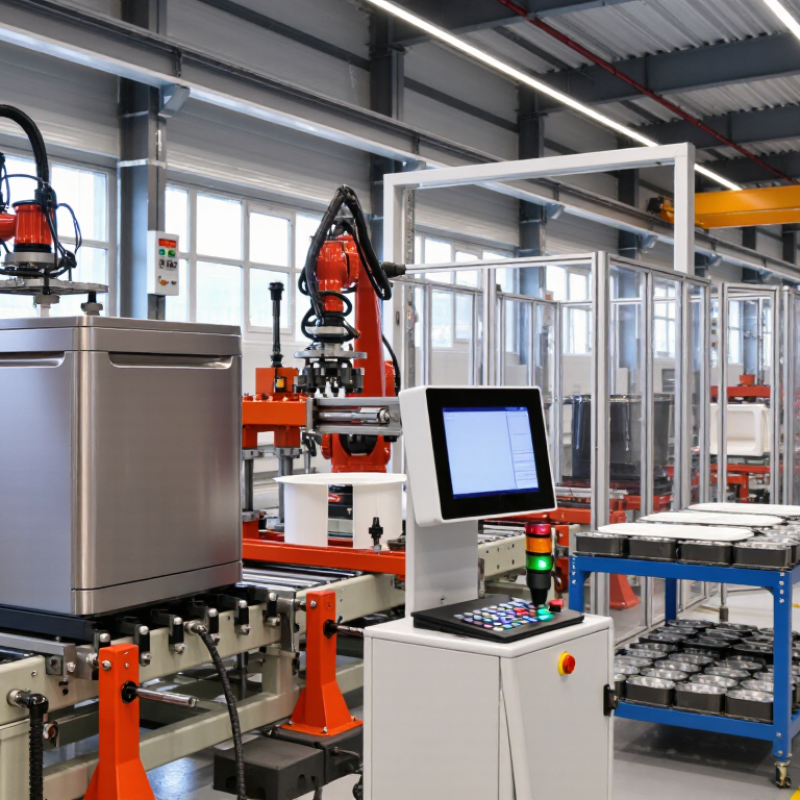
Before comparing equipment, define what the dishwasher tub assembly line must produce. Set a target in finished tubs per hour, then check whether it matches actual shift patterns and planned demand. Specify tub dimensions, material thickness, surface finish, and the number of models. A line handling one tub size may need different tooling from one switching between several sizes each shift. Leave room for changeovers. They take time.
Clarify where the line begins and ends. Will it form panels, join the tub, and check for leaks, or receive preformed parts? List each operation and its expected cycle time. Pay close attention to bottlenecks such as corner joining or inspection. Define measurable quality limits, including tub dimensions, joint consistency, and acceptable leakage. A small dimensional variation can complicate later assembly. Do not rely on general terms like “high quality”; record inspection methods and pass criteria.
Also document the available floor space, power, compressed air, staffing, and material flow. A detailed layout can reveal whether large panels will cross walkways or wait between stations. Include changeover time and maintenance access in capacity estimates. Early figures are often optimistic. Review them against real shift data, and revise the requirements before requesting line proposals.
Choosing a dishwasher tub assembly line starts with the tub material and product range. Deep-drawing presses shape a single sheet into a shell, reducing seams but demanding careful control of blank size, lubrication, and press force. Multi-stage forming can handle complex corners and deeper tubs, though each extra station adds tooling and maintenance needs. Roll forming suits straight sections and repeatable profiles, but it is less suitable for a fully formed, one-piece tub.
Assembly technology determines how consistently panels, flanges, and seals meet. Spot welding is fast for compatible metal joints, while laser welding can create narrow seams with limited distortion when fit-up is accurate. Mechanical hemming avoids some heat effects, but requires precise edge preparation. Automated handling improves repeatability; however, a poorly tuned fixture can reproduce the same error all day. That part is easy to underestimate. Check sample tubs for diagonal measurements, corner fit, and leak performance, not just cycle time.
Tips: Compare technologies using your actual tub geometry and target output. Ask suppliers to run representative material, then inspect formed corners and finished seams. Leave room for adjustment; production rarely behaves exactly like a trial run.
Compare tub-forming and assembly technologies by the core operations in each workflow.
How to read this chart: The bars count the core process steps listed for each workflow: stainless-steel deep drawing, polymer injection molding, and tub assembly. They are process-step counts, not production benchmarks; actual operations and line layouts vary by design and equipment.
Start with the required output, not the machine’s headline speed. Calculate daily demand using actual shifts, planned changeovers, and realistic downtime. Then compare that figure with the line’s demonstrated cycle time. A line rated for 60 tubs per hour may produce less when operators load parts manually or sealing stations need adjustment. Ask suppliers for acceptance-test results using comparable tub dimensions and materials. Small details matter.
Automation can stabilize repetitive tasks such as positioning, fastening, and sealant application. But more automation is not automatically better. The International Federation of Robotics reported 553,052 industrial robots installed worldwide in 2022, a 5 percent increase from 2021. This signals broad adoption, not proof that a robotic cell suits every assembly operation.
Examine labor availability, maintenance skills, spare-parts access, and recovery procedures after faults. How long does a stopped station take to restart?
Flexibility protects the line when product designs change. Check whether fixtures, grippers, and programs can accommodate different tub sizes without lengthy retooling. Request a trial changeover with a target time and inspect the result for leaks, scratches, and dimensional variation. Also review data collection: station-level cycle times and fault logs help identify bottlenecks after installation. Do not rely only on a polished demonstration. Real production is messier. A modest line with proven changeovers may outperform a faster system that struggles with product variation.
Quality control should guide every equipment decision. Inspect how the line handles stainless steel sheets, insulation, gaskets, and welded joints. Request sample records for leak tests, dimensional checks, and torque verification. A reliable supplier should explain inspection points clearly, not hide behind general claims. Ask to see calibration records for pressure gauges and fastening tools. Small measurement errors can create noisy operation or water leakage later.
Safety must be visible on the factory floor. Check guarding around presses, welders, conveyors, and robotic stations. Emergency stops should be easy to reach and tested during acceptance trials. Interlocked doors, light curtains, ventilation, and heat protection deserve careful review. Operators also need comfortable working heights and clear material paths. I have seen efficient lines become unsafe when cable routing was treated as an afterthought. It looked minor. It was not.
Factory integration affects long-term performance. Confirm that the line can exchange production data with quality and inventory systems. Barcode tracking should connect each tub to its inspection results and operator record. Review changeover time for different tub sizes, because optimistic estimates often fail on the floor. Maintenance access matters too. Filters, sensors, and welding parts should be reachable without dismantling half the station. Run a full trial with real materials before approval. A smooth demonstration is useful, but repeated production tests reveal weaknesses. Leave room for adjustment; no assembly line is perfect on its first day.
How to Choose a Dishwasher Tub Assembly Line?
Assess the complete cost, not only the purchase quotation. Include installation, tooling, utilities, training, spare parts, software updates, and planned maintenance. A lower-priced line may require more manual inspection and create higher labor costs. It may also increase rejected tubs. Small losses accumulate quickly. The U.S. ENERGY STAR program reports that certified dishwashers use about 3.2 gallons of water per cycle, compared with roughly 5 gallons for standard models. This highlights why water, energy, and leak-testing efficiency deserve attention during line selection. The same principle applies to production equipment.
Supplier support strongly influences long-term value. Ask for documented response times, spare-parts availability, remote diagnostics, and technician training. Request sample cycle-time records under comparable product conditions. The International Federation of Robotics reported 541,302 industrial robots were installed worldwide in 2023. Automation is expanding, but advanced equipment still needs skilled support. A line that stops for three days can erase months of expected savings. Include maintenance access in the factory review. Can workers reach sensors without removing large guards? Can operators change tub sizes without excessive adjustment? These details are easy to overlook. My cost model would still include a risk allowance, because optimistic forecasts rarely survive production. Compare five-year ownership cost, uptime evidence, service quality, and upgrade flexibility before choosing the assembly line.
Planning comparison for a line covering tub handling, assembly, fastening, sealing, inspection, and material transfer. Figures are indicative estimates in USD—not supplier quotations. Actual costs and output depend on product design, automation scope, plant conditions, and required quality controls. Building work and upstream tub forming are excluded.
| Evaluation dimension | Manual / semi-automatic | Modular semi-automatic | Highly automated |
|---|---|---|---|
| Indicative installed equipment cost | $0.4–0.9 million | $0.9–2.0 million | $2.0–5.0 million or more |
| Indicative line output | About 8–15 units/hour | About 20–35 units/hour | About 40–70 units/hour |
| Typical staffing per shift | Higher; roughly 8–14 operators, depending on layout and tasks | Moderate; roughly 5–9 operators | Lower direct labor; roughly 3–6 operators plus maintenance support |
| Best fit | Lower-volume production, pilot programs, or frequent product changes | Medium-volume production needing a balance of flexibility and repeatability | Stable, high-volume production with a clear business case for automation |
| Changeover and product flexibility | Generally easiest to adapt; more manual adjustment and training may be needed | Good when fixtures and stations are designed for defined model families | Can be quick with validated recipes and tooling; changes may require engineering work |
| Quality and process controls | Visual checks and manual records; consistency relies more on standard work | Add poka-yoke, torque monitoring, and in-station checks where needed | Can support traceability, interlocks, automated inspection, and process data capture |
| Long-term cost drivers | Labor, ergonomics, rework, and training as output grows | Labor, fixture wear, controls maintenance, and model-change tooling | Controls and robot support, specialist maintenance, spare parts, and software updates |
| Supplier support to verify | Request a defined response-time commitment, installation and ramp-up plan, operator and maintenance training, warranty terms, recommended spare-parts list, and availability of remote or on-site troubleshooting. | ||
| Acceptance and documentation | Agree on factory and site acceptance tests using representative products. Request cycle-time results, quality criteria, safety documentation, electrical drawings, equipment manuals, and editable control-system backups as applicable. | ||
| Long-term value check | Compare total cost of ownership over the same period: installed equipment, labor, utilities, maintenance, spare parts, tooling, planned downtime, training, and expected rework. Validate assumptions against your production schedule and product mix before selecting a line. | ||
Output, staffing, and cost ranges are indicative planning values only. Ask each supplier to state the included equipment, exclusions, assumptions, guaranteed performance conditions, and ongoing support costs in writing.
sale@harbertpump.com,
sale@harbertpump.com