China’s Hot Rolled Steel Sheet Pile sector supports ports, metro systems, cofferdams, riverwalls, and deep foundation works. The demand is practical and highly project-specific. A sheet pile may face water pressure, vibration, corrosion, and repeated driving impacts.
The World Steel Association’s World Steel in Figures 2024 reports approximately 1.89 billion tonnes of crude steel production worldwide in 2023. This figure shows the scale of the steel industry, but it does not rank sheet pile manufacturers. The China Top 10 Hot Rolled Steel Sheet Pile Suppliers list therefore needs a narrower evaluation. Production capacity, Z-section and U-section availability, steel grades, mill certificates, delivery performance, and completed project experience all matter. Standards such as EN 10248, EN 1993-5, and ASTM specifications provide useful technical references.
Professor John Burland’s warning, “Soil is a natural material,” remains highly relevant here. Ground conditions rarely behave exactly as drawings predict. Small differences in clay layers, groundwater levels, or driving equipment can change performance. This article compares leading Chinese suppliers through available technical evidence, export records, quality systems, and customer-facing capabilities. Some rankings may remain imperfect. That is worth admitting.
Look closely at the details.
The strongest supplier is not always the largest mill. A contractor may need 12-meter piles, tight interlocks, rapid replacement stock, or verified weldability. Practical experience should balance published claims. The following overview aims to help engineers, buyers, and international contractors make a more informed shortlist.
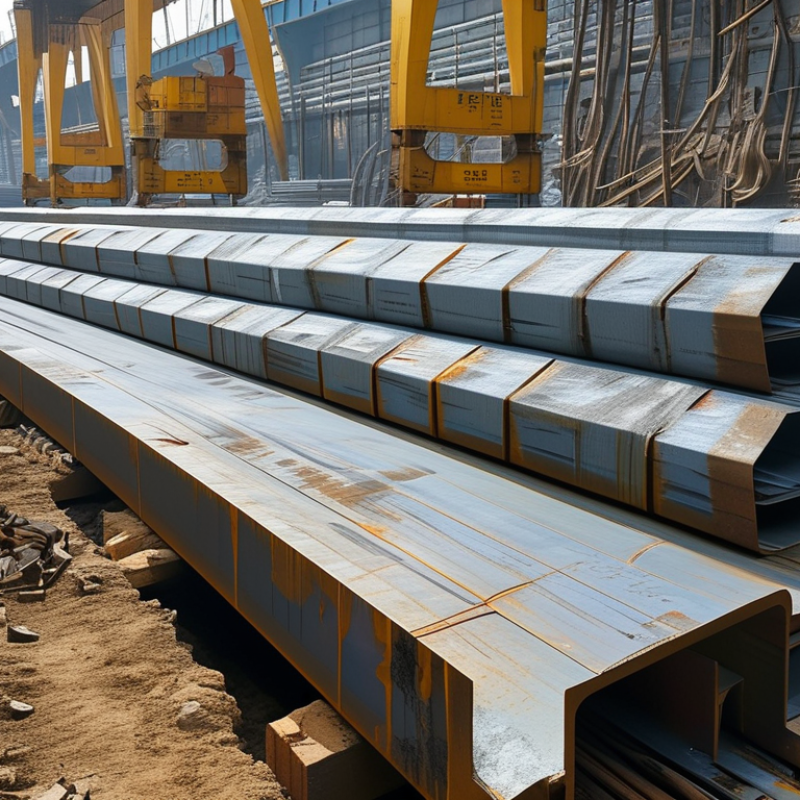
Hot rolled steel sheet piles are interlocking steel sections used to retain soil or water. They are formed at high temperatures, creating strong edges and consistent structural shapes. Unlike cold-formed piles, hot rolled sections usually provide deeper interlocks and better resistance to driving stress. Their rolled geometry helps create continuous walls with fewer leakage paths. A typical installation uses a crane, guide frame, and vibratory hammer. Site measurements still matter.
Common types include U-shaped, Z-shaped, and straight-web profiles. U-shaped piles offer broad flanges and practical handling during temporary excavation work. Z-shaped piles place more steel away from the neutral axis, improving bending efficiency. Straight-web piles are useful where interlock strength and tension resistance are important. Engineers select a profile according to soil pressure, water level, wall height, and reuse plans. The strongest section is not always the most economical choice.
These piles support basements, ports, flood barriers, bridge abutments, cofferdams, and riverbank protection. In a waterfront excavation, interlocked sheets can reduce soil movement beside a working platform. Vibratory hammers often limit installation time, but hard gravel, buried concrete, and nearby buildings can complicate driving. Corrosion allowance also deserves attention, especially in tidal or industrial environments. Supplier evaluation should include mill certificates, section tolerances, coating records, and load data. Paperwork helps, but field inspection remains essential. Designs can look precise on paper, while ground behavior remains uncertain.
| No. | Technical Dimension | Typical Options or Data | Definition or Function | Common Applications | Key Considerations |
|---|---|---|---|---|---|
| 1 | Product definition | Interlocking hot rolled steel sections | Steel sheet piles are rolled sections driven into the ground or seabed to form a continuous retaining or cutoff wall. | Retaining walls, cofferdams, quay walls, flood barriers, and excavation support | Wall performance depends on section geometry, steel grade, embedment depth, soil conditions, and bracing. |
| 2 | U-shaped sheet piles | U-profile with the interlocks positioned near the neutral axis | A traditional profile family that provides good bending resistance and flexible wall assembly. | Temporary excavation walls, riverbank protection, cofferdams, and small marine structures | Often suitable for reuse, but the effective section properties may be influenced by interlock slip and connection condition. |
| 3 | Z-shaped sheet piles | Z-profile with the interlocks located near the outer edges | A high-efficiency profile that places more steel away from the neutral axis to increase section modulus. | Deep permanent walls, port structures, bridge abutments, and major earth-retaining works | Generally offers efficient steel usage for higher bending demands; driving conditions and interlock strength must be checked. |
| 4 | Straight-web sheet piles | Flat or straight-web sections with strong interlocks | Sections designed primarily to resist hoop tension and form cellular structures rather than act as ordinary cantilever beams. | Circular cells, cellular cofferdams, bulk storage structures, and large temporary enclosures | Connection strength and cell geometry are critical; they are not normally selected solely on conventional bending capacity. |
| 5 | Combined wall systems | Primary tubular or H-shaped king piles with sheet pile intermediates | A composite wall arrangement used to achieve higher stiffness, bending resistance, or wall depth than individual sheet piles can provide. | Deep quay walls, heavy marine walls, bridge approaches, and large excavation projects | Requires accurate fabrication, alignment, connection detailing, lifting planning, and specialized driving equipment. |
| 6 | Typical steel grades | Structural grades commonly specified by national or international standards | Steel grades define yield strength, tensile strength, elongation, weldability, and inspection requirements. | General civil engineering, marine construction, infrastructure, and temporary works | The selected grade should match the design code, required toughness, welding procedure, temperature exposure, and corrosion allowance. |
| 7 | Standard length range | Commonly supplied in approximately 6–24 m lengths; project-specific lengths may be available | Length determines the achievable embedment, unsupported height, handling method, and number of field splices. | Temporary works, permanent retaining walls, waterfront construction, and flood-control projects | Transport restrictions, crane capacity, driving rig height, ground obstructions, and splice design must be considered. |
| 8 | Manufacturing process | Hot rolling, straightening, cutting, inspection, and bundling | Hot rolling forms the complete cross-section and integral interlocks in a continuous mill process. | Projects requiring repeatable geometry, high production volume, and reliable interlock engagement | Quality checks typically include dimensions, straightness, surface condition, mechanical properties, and interlock compatibility. |
| 9 | Installation methods | Vibratory driving, impact driving, pressing, and pre-drilling where appropriate | Installation transfers the piles into the ground while maintaining alignment and interlock engagement. | Urban excavations, marine sites, hard ground, soft soils, and vibration-sensitive locations | Equipment selection depends on soil resistance, pile size, access, noise limits, nearby structures, and allowable vibration. |
| 10 | Applications and service life | Temporary or permanent use; bare, coated, or corrosion-protected steel | Sheet piles provide earth retention, water cutoff, hydraulic protection, and structural support. | Basements, underground stations, ports, seawalls, flood defenses, river training, and contaminated-site barriers | Service life is governed by corrosion environment, water chemistry, tidal exposure, coating system, sacrificial thickness, and maintenance. |
sale@harbertpump.com,
sale@harbertpump.com,
sale@harbertpump.com,
sale@harbertpump.com,
sale@harbertpump.com