
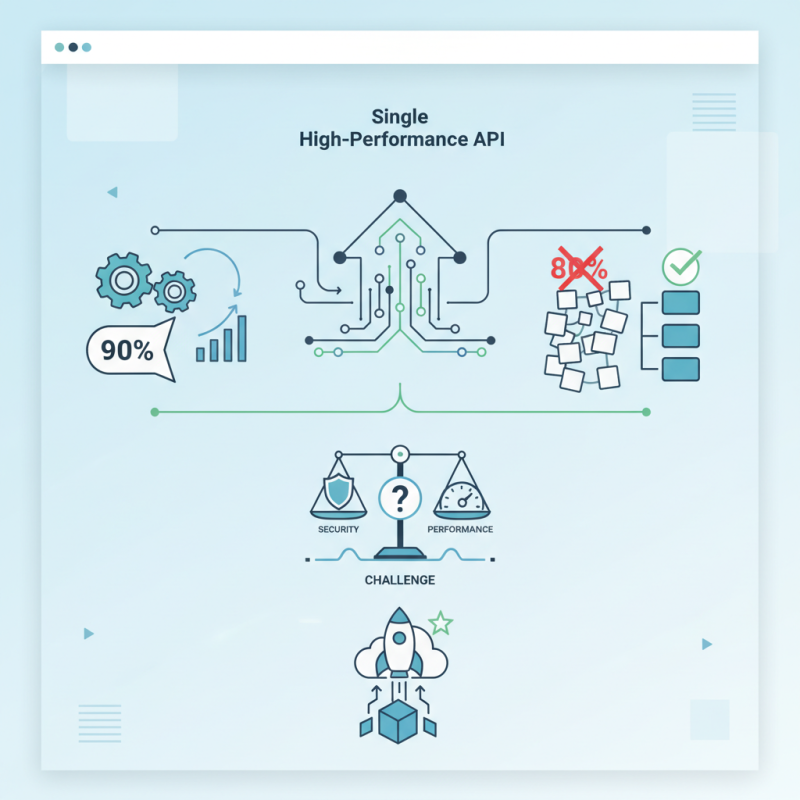
In today's rapidly evolving digital landscape, businesses need to adapt quickly. A Single High-Performance API is essential for achieving this agility. According to a recent survey by ProgrammableWeb, 90% of businesses that implement APIs report improved operational efficiency. This statistic highlights the importance of streamlined communication and data exchange.
Creating a Single High-Performance API can simplify complex processes. Companies often struggle with multiple APIs that lack cohesion. Research from Gartner indicates that 80% of API projects fail due to poor design or integration challenges. Thus, focusing on a single, efficient API can reduce risks and enhance performance.
However, developing such an API is not without challenges. Designers must consider scalability and security. The balance between performance and safety is a crucial area for reflection. As businesses transition to a digital-first model, adopting a Single High-Performance API serves as a foundational step toward long-term success.
APIs are crucial for businesses today. They enable different software systems to communicate smoothly. This interaction is often key to improving efficiency and user experiences. A well-designed API can streamline processes, reduce redundancies, and enhance data sharing. When businesses invest in a solid API, they open avenues for innovation and better service delivery.
Understanding API fundamentals is essential. It begins with recognizing how APIs expose specific functionalities. This means third-party applications can access them securely. Each API must be user-friendly and easy to integrate. Many companies struggle with documentation; it often lacks clarity. Without clean guidelines, developers waste time and resources. A clear API increases developer engagement and satisfaction. Additionally, ensuring security is vital. Poorly secured APIs can expose sensitive data. Balancing accessibility with security remains a challenge for many firms.
Investing in testing is necessary yet often overlooked. Conducting comprehensive testing ensures reliability and performance. It helps identify flaws early. Businesses should involve end-users in the testing process to gather real feedback. Many miss this step and face issues later on. Continuous improvement should focus on user needs. APIs must evolve with changing technologies and market demands. Understanding and refining these aspects is essential for long-term success.
| Dimension | Description | Importance |
|---|---|---|
| Endpoint Design | Structuring endpoints effectively to ensure clarity and accessibility. | A well-designed endpoint promotes better usability and integration. |
| Authentication | Implementing robust security protocols to protect data. | Crucial for safeguarding sensitive information and user trust. |
| Data Formats | Choosing optimal data formats such as JSON or XML. | Efficient data handling enhances performance and reduces latency. |
| Rate Limiting | Controlling the number of requests a client can make over a period. | Prevents abuse and ensures stable performance under high load. |
| Versioning | Managing different versions of the API for improving features without breaking existing functionalities. | Essential for continuous development and client adaptability. |
Identifying business needs is essential for building a high-performance API. Start by assessing workflows. What processes require integration? Engage with stakeholders early. Their insights help shape the API features. Understand the data flow between systems. This is critical for optimizing performance.
Consider specific use cases. Is your API for mobile apps, web services, or internal tools? Each use case has different needs. For instance, a mobile API may prioritize speed due to unstable connections. A web service API might focus on scalability and security. Collect feedback continuously. APIs should evolve based on user interaction.
Think about potential gaps. Not all assumptions will hold. You might overlook a critical user group. Data privacy and compliance can be challenging areas. Maps out all scenarios, even the unlikely ones. A well-rounded understanding leads to better designed solutions.
Designing a high-performance API architecture is crucial. Studies show that 83% of developers face challenges in API performance. A key element is the API's scalability. As user demands grow, the architecture must adapt without compromising speed or reliability. Using microservices can help. This approach allows for independent deployment and scaling, handling traffic spikes effectively.
Another significant factor is efficient data management. APIs need quick access to data. Caching strategies can reduce load times. A report indicated that 47% of consumers expect web pages to load in two seconds or less. When APIs lag, users are likely to abandon applications. Slow APIs lead to frustration.
Testing is essential in API development. Many teams neglect it, which can cause issues later. Continuous integration helps identify problems early. However, the process can be time-consuming. Without proper testing, scalability and efficiency may suffer. Monitoring tools can provide insights, but they often add complexity. Balancing these elements requires careful planning and reflection.
This bar chart illustrates the performance metrics of a high-performance API, showcasing its response time, error rate, throughput, and uptime. Monitoring these metrics is crucial for ensuring that the API remains efficient and scalable for business needs.
In today’s fast-paced digital landscape, API development requires a focus on security to safeguard data. A recent report indicates that 90% of organizations experienced at least one API security incident in the past year. This highlights the urgency of implementing best practices. Start with authentication and authorization methods like OAuth and API keys. They create barriers against unauthorized access. However, relying solely on these methods can be risky if not paired with regular security audits.
Monitoring your API performance is crucial. In fact, 80% of developers revealed they encounter performance issues due to security constraints. Use tools to log API requests and responses. These logs can help identify vulnerabilities. Additionally, consider rate limiting to prevent abuse. This approach can lead to performance degradation.
Reflect on how often your API is accessed. If it's not optimized for heavy traffic, it may fall prey to DDoS attacks. Remember, securing your API is not a one-time task. It requires continuous evaluation and improvement to adapt to evolving threats.
API performance is critical for business success. Monitoring tools can provide insights into response times and error rates. According to a recent report, 83% of companies experienced API failures due to inadequate testing. This can lead to poor user experience and lost revenue. Continuous monitoring helps catch issues early. Regular checks can reduce downtime significantly.
Optimizing performance is an ongoing process. One common pitfall is neglecting to assess API response under load. Businesses should simulate high-traffic scenarios. Research shows that 70% of slow APIs can be improved with proper optimization techniques. Caching strategies and efficient database queries often yield positive results. However, teams might rush through these enhancements, leading to overlooked areas.
Testing should not be a one-off task. Frequent testing can catch regressions early. The industry standard suggests running performance tests weekly. Only 45% of companies adhere to this practice. It’s easy to fall into complacency, thinking everything works fine. Regular performance audits reveal strengths and weaknesses. Understanding these metrics fosters a culture of constant improvement.
sale@harbertpump.com,
sale@harbertpump.com