Machine Safety Fence systems are becoming essential as factories add robots, conveyors, automated presses, and collaborative equipment. A well-designed fence creates visible distance between people and moving hazards. It also supports controlled access, inspection, and safer maintenance routines.
Industry forecasts show strong demand. MarketsandMarkets estimates that the global machine safety market could grow from about USD 5.4 billion in 2023 to more than USD 7 billion by 2028. Grand View Research also reports continuing expansion in industrial safety equipment, driven by automation and stricter risk-management expectations. These figures describe broad markets, not fencing alone. That distinction matters.
A fence is not a complete safety strategy.
ISO 14120 emphasizes suitable guard design, secure construction, and protection against foreseeable access. In practice, manufacturers must consider panel strength, mesh openings, gate switches, emergency access, corrosion resistance, and installation quality. A bright yellow panel may look reassuring, but poor anchoring can still create a serious weakness.
Dr. Nancy Leveson, an MIT system-safety expert, states, “Safety is an emergent property of systems.” Her observation fits Machine Safety Fence selection closely. The fence, interlock, control system, work process, and operator training must function together. One component cannot carry the entire risk.
This 2026 guide evaluates leading Machine Safety Fence manufacturers and suppliers through product quality, customization, documentation, global service, and practical application experience. Supplier claims are not always comparable. Some data is self-reported, and rankings can change by region or project type. Readers should verify certifications, test evidence, installation support, and lifecycle costs before making a final decision.
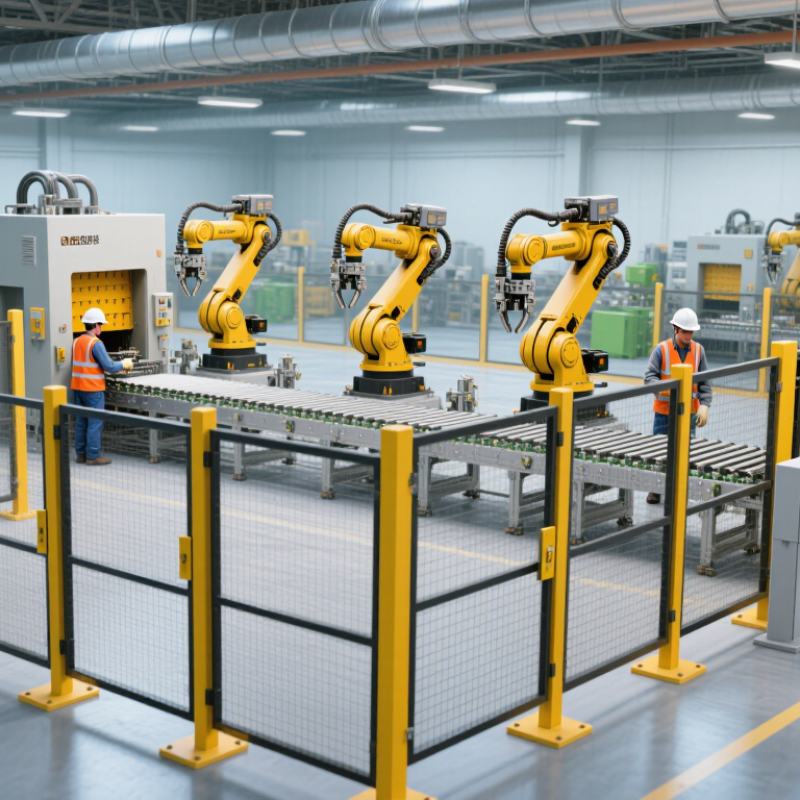
Machine safety fences create a controlled boundary around hazardous moving parts, robots, and automated work cells. They help prevent accidental contact while allowing operators to observe production. A well-designed fence also supports safe cleaning, adjustment, and maintenance. It is not merely a steel barrier.
ISO 14120:2015 requires guards to suit the machine’s hazards, operating conditions, and foreseeable misuse. Designers should consider strength, rigidity, corrosion resistance, visibility, and safe access. Mesh openings and fence distances must prevent hands, arms, or tools from reaching danger zones. These dimensions should be checked with the applicable safety-distance requirements, including ISO 13857. Fixed guards should require tools for removal, while movable guards may need position monitoring under the machine’s risk assessment.
Details matter.
A practical inspection may reveal sharp edges, loose fasteners, excessive gaps, or a gate that opens toward a hazard. Such defects can undermine an otherwise careful design. Suppliers should provide traceable materials, clear installation instructions, and evidence of tested performance. The final arrangement must also account for emergency access, maintenance routes, lighting, and operator visibility. A fence that blocks sightlines can encourage bypassing, which is an uncomfortable but realistic design failure. Risk assessment should therefore continue after installation, because production changes can create new access points.
2026 Top Machine Safety Fence Manufacturers and Suppliers
A machine safety fence begins with a documented risk assessment, not a catalog search. ISO 12100 helps teams identify hazards, estimate risks, and select protective measures. On a production floor, assess crushing points, robot reach, unexpected restarts, and access during maintenance. Mark each hazard beside the machine layout.
The fence controls access, but it does not automatically create a safe system. Doors, interlocks, emergency stops, and guard-locking devices may form safety-related control parts. EN ISO 13849-1:2023 uses the required Performance Level, or PLr, to guide their design. Designers evaluate architecture, MTTFd, diagnostic coverage, and common-cause failures. The resulting level ranges from PL a to PL e. Higher risk usually demands stronger performance.
Measure twice.
A practical review should test every access route, including gaps beneath panels and spaces near conveyors. Validate stopping time with real tooling, product loads, and machine speed. A small timing error can leave dangerous motion active after the door opens. Records should show the hazard, chosen PLr, protective response, test method, and responsible reviewer. Incomplete drawings remain a weakness. They often hide shared wiring, poor reset locations, or maintenance shortcuts. The assessment may need revision after production changes, because a new fixture can alter reach distances and stopping performance.
For 2026, the strongest machine safety fence manufacturers are ranked by customization, compliance, and production capacity. Customization leads because factory layouts rarely follow standard dimensions. Reliable suppliers should adapt panel heights, access gates, robot clearances, and sensor positions without weakening the barrier. Look for welded mesh options, modular posts, adjustable feet, and clear maintenance access. Small details matter.
Compliance requires more than a certificate on a website. Manufacturers should provide risk-assessment support, load data, installation instructions, and traceable material records. Their designs should align with applicable machinery safety standards and local workplace requirements. Practical audits often reveal missing drawings or unclear gate interlocks. Documentation matters. A polished product can still fail during installation.
Capacity separates dependable suppliers from occasional fabricators. Evaluate monthly output, tooling depth, quality inspection points, and spare-part availability. Ask how the supplier handles urgent changes after approval. A large facility is not automatically better. Capacity without process control creates inconsistent panel spacing, coating defects, or delayed replacements. This ranking approach is imperfect because factory performance changes with staffing, materials, and project complexity. Buyers should verify current lead times, sample quality, and installation experience before selecting a supplier. The best partner combines flexible engineering, measurable compliance, and stable output, rather than claiming excellence in only one area.
2026 Top Machine Safety Fence Manufacturers and Suppliers
Choosing a machine safety fence supplier requires more than comparing panel prices. Lead time often changes with mesh size, door design, coating, and custom dimensions. Experienced suppliers usually confirm these details before issuing a firm schedule. A practical benchmark is three to six weeks for standard systems, while engineered layouts may require longer. Ask whether drawings, risk-based layout support, and installation guidance are included. These services can prevent costly changes around conveyors, robots, and maintenance gates.
Global coverage also affects reliability. Suppliers with regional warehouses or trained installation partners can respond faster when replacement panels or hinges are needed. Check export packaging, technical documentation, spare-part availability, and communication during production. A supplier may claim worldwide delivery, yet offer limited support after arrival. That gap matters. I have seen projects delayed by one missing gate latch.
Tips: Request a sample layout, production milestones, and a written packing list. Confirm corrosion protection for humid or dusty areas. Ask who handles site questions across different time zones. Keep safety distance requirements visible in every drawing. A low quotation can be useful, but it should not hide weak engineering support or unclear delivery terms. Prices move. Lead times move too. Manufacturers that explain these risks clearly are often easier to trust.
A reliable safety fence starts with the hazard, not the panel design. Buyers should request an ISO 13857 assessment for each machine layout. Safety distances depend on access direction, opening size, and the body part that could reach the hazard. There is no universal gap that fits every application. Measure from the nearest reachable fence point to the dangerous moving part. Check hands, arms, feet, and legs separately. Small mistakes matter.
Ask suppliers for tested mesh dimensions, post load data, anchor specifications, and installation tolerances. The fence should resist expected impact and remain stable during normal production. Panels must not create climbable footholds or unexpected reach-through openings. Gates require suitable hinges, latches, and interlocking where risk assessment demands controlled access. Keep fasteners secure. Do not rely on appearance alone.
Installation quality often decides whether a compliant design works safely. Inspect concrete anchors, panel alignment, clearance, and damaged coatings during handover. A drawing may look perfect, yet a tilted post can reduce the intended safety distance. Recheck after conveyor changes, tooling updates, or floor repairs. Supplier instructions should explain inspection intervals and replacement parts. One practical weakness remains: site measurements are sometimes rushed. Leave room for correction before production starts, and record every change clearly.
sale@harbertpump.com,
sale@harbertpump.com